Thursday, May 27, 2010

Trees of Life

What's the difference between a pile of wet dirt steaming in the sun, and a tree?

I've asked people this question before and have gotten that is-he-off-his-meds look from them. But it's simple enough: a tree and a pile of wet dirt are composed of the same stuff. The difference is that the tree is alive, has life, is a life. That means it takes the moisture and dirt and air and sunlight and transforms it through self-sustained processes into a structure, a form. In effect, the life of the tree takes the raw materials - literally earth, water, air and fire - and uses them to assemble a form to realize or manifest itself.

The form it takes is a branching fractal, and in fact a tree is the paradigm for all such geometric shapes; for example, a chart that shows the branching of lines of descent from an ancestor is known as a family "tree."

Which brings me to the next question that tends to elicit "that look" from people: Where does life come from?

I hasten to add that I'm not asking about the origin or ultimate source of all life; rather, simply this: If we look at a specific living thing, where did its life come from? And the simple answer is: from another living thing. Life comes from life.

What a family tree shows, from this point of view, is the history of transmission of life through successive generations, as it branches, re-branches and multiplies.

Trying to trace these lines of transmission, as I indicated in my last post, can get to be a pretty complex task. And it gets even more complex if you consider that your personal family tree is just one of billions of sub-branches of the overall human family tree, which in turn is just a sub-branch of the mammalian family tree, which again is a sub-branch of a yet-larger "tree of life."

Here's one attempt to represent this situation graphically (click to enlarge; right-click to open in a new browser window):


(Source: Wikipedia)


Drastically simplified as this picture is, it does get the basic idea across, with special emphasis on the tree-like nature of the relationships.

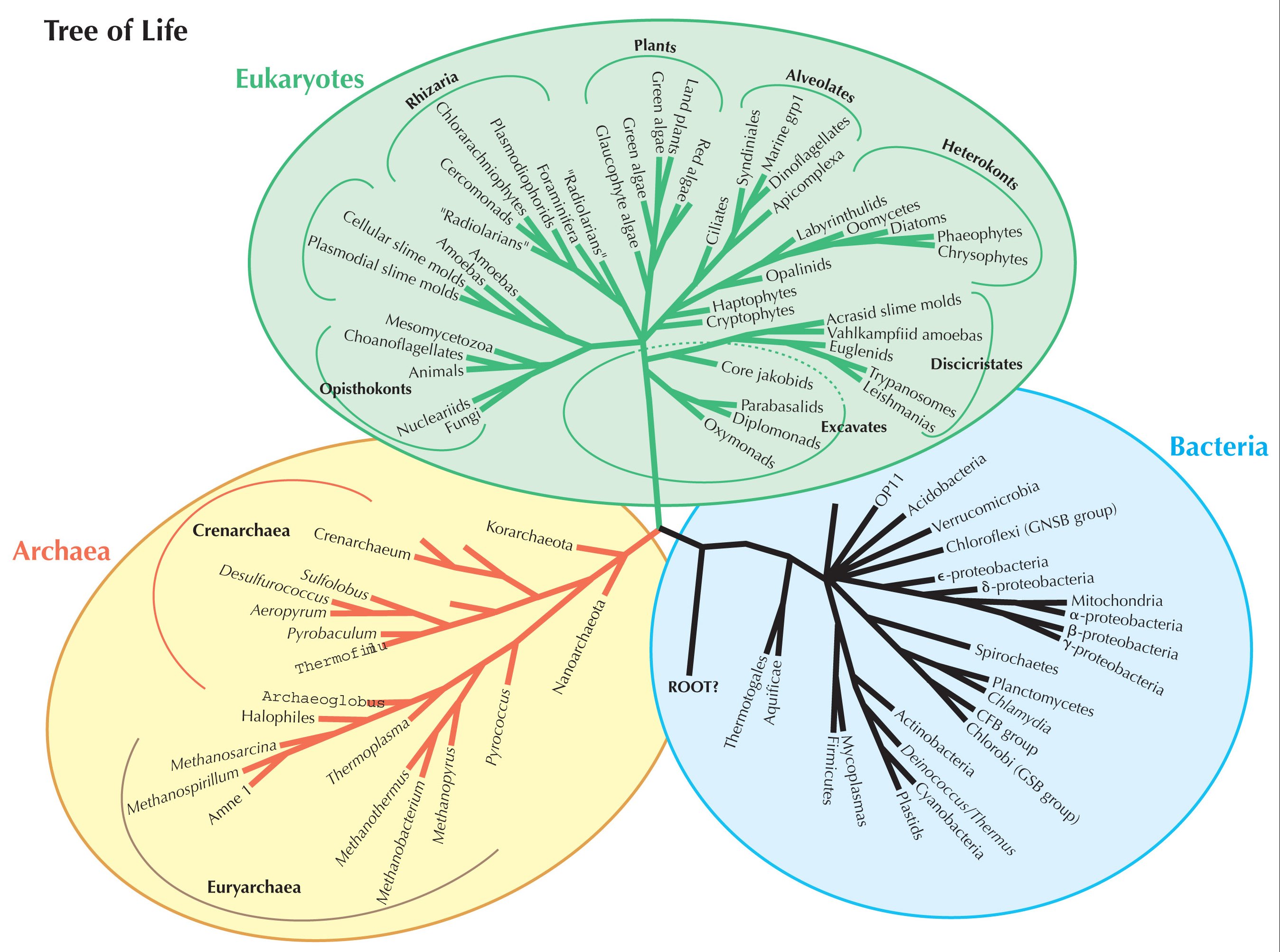
This next one is much more scientifically up-to-date and gives a better picture of how complicated these life-connections have become over time:

(Source: Cold Spring Harbor Laboratory Press)

Even this diagram, however, exhibits a tree-like branching structure that fans out from a single point of origin. Now, there's obviously a lot of room for debate about the exact nature of that point of origin - was it an act of divine creation, or a chance combination of organic chemicals, or the arrival on earth of some existing simple organism from the far reaches of space? - but we can safely ignore that question for now. The point is that all subsequent life consists of an uninterrupted transmission from that one original source.

Here's one more example of a tree-like branching fractal structure:


(Source: U.S. Geological Survey; photo of Selenga River delta on the southeast shore of Lake Baikal, Russia.)

What does this river delta have in common with a tree, apart from a branching structure? I would argue that both can be thought of as objects created by a type of outflow. That's obvious in the case of the river, but perhaps not so obvious with regard to a tree. But I think it's a true way of looking at a tree's growth: The life within the tree is creating a flow up into the sky by assembling its outstretching branching structure, just as the gravitational energy of the river causes it to flow into the sea, depositing a similar structure as it does so.

In the very same way, the tree-of-life diagrams above chart the outflow over the eons of life itself. What we see in these diagrams, in other words, is the history of the flow of a single stream with many branches, just like the one in the satellite photo.

In short, all life on earth is one life flowing from a single wellspring through myriad branches. From that perspective, each individual living thing is related to every other living thing in the same way as the separate leaves on a gigantic tree, or as the fingers of one individual human's hands: distinguishable as objects of a kind in themselves, but impossible and meaningless without their connection to a larger life.

I suggested last time that when we stand in line at the grocery store, there's a fair chance that the cashier or some of the other customers may be our cousins. But clearly, our relatedness is ultimately much closer, much more intimate: There is only one life, a single self-same life, in all of us. It enlivens each of us for a time as it flows through us from its unknown past toward its unguessable future.

Knowing that, how can I possibly regard you or any other living being with ill-will?

Tuesday, May 25, 2010

Howdy, Cousin

Our culture is so conditioned to the idea that a society is formed by the voluntary association of individuals that it may come as an actual shock to some people to learn that there are alternative models of social formation. In fact, as I think everyone realizes deep down, the original mode of social organization was kinship. And this remained the dominant mode until very recent times, by way of a series of extensions or expansions: from family to clan to tribe to nation, with accompanying formalizations of relationship and status, reaching a peak of elaboration in the kind of hierarchical society exemplified by, say, the court of Louis XVI.

Now, I'm not going to argue that humanity's needs would best be met by a return to monarchy and hierarchy. But I am going to suggest that something of real value is lost in the current atomistic-individualistic view of things. In the understandable rejection of tyrannical absolutism, we’ve gone a bit too far in the opposite direction. One way of looking at it: In the famous revolutionary triad of "Liberté, Égalité, Fraternité," the present-day view seems to regard them as listed in descending order of value; indeed, "fraternité" seems largely to have gone off the radar in our hyper-competitive, social-Darwinist era.

The fact that we humans really are all members of one big family can be illustrated by something I’ve been mulling over recently:

Every human being has two parents. You have two parents, your parents had two parents each, giving you four grandparents, each of whom had two parents, giving you eight great-grandparents, and so on. So in looking back at your ancestry, the number of your ancestors doubles with each generation further back you look.

There's a conundrum here. At this geometric rate of expansion, by the time you get back to your 28-times-great grandparents, you've got a billion ancestors in that one generation. Allowing 20-30 years per generation, that would have been the situation somewhere between 600 and 900 years ago, i.e., sometime between the years 1100 and 1400. But according to experts' best estimates, the total human population didn't reach 1 billion until the early 1800s. And the disparity just gets bigger as you keep counting backwards: If you go back a further 30 generations, the number of your ancestors in that one generation rises to a staggering 1.2 quintillion; meanwhile, the actual population on Earth has shrunk to an estimated 200 million.

So how can we reconcile the obvious truth that everyone has two parents with the equally obvious truth that the human population gets smaller the further back in time we look? I think there's only one explanation: Among those theoretical 1 billion or 1.2 quintillion people, there's a lot of duplication. In other words, the same couples appear multiple times in a given generation, making them your ancestors along multiple lines of descent.

Suppose, for instance, you lived in the 15th-century and your father hiked 20 miles to a (to him) distant village to find his bride. Well, there's a fair chance that his great-great-great grandfather did the same thing in the opposite direction. So your father might have ended up marrying his fourth cousin, and you would have the same 4-times-great grandparents on both your mother's and your father's side – which, incidentally, would make you your own fifth cousin.

What this boils down to is that when you're standing in line at the grocery store, there's a pretty good chance that the cashier or some of the other people in line are your not-terribly-distant cousins. And if you don't believe a more or less random selection of people can turn up these kinds of family connections, recall that during the 2008 presidential campaign, the genealogical experts at Burke's Peerage informed the world that Barack Obama is an 11th cousin of George W. Bush and a ninth cousin of Dick Cheney.

Everyone is aware that all humans are related on the basis of the so-called "mitochondrial Eve" or whatever, but that kind of connection goes back tens of thousands or hundreds of thousands of years, so it may seem pretty remote and not very relevant to our lives today. But it turns out not to be necessary to look back anywhere near that far to see how connected we are, how closely related we all are.

Regrettably, in an age when social atomism has reached such an extreme that even the nuclear family seems increasingly fissile, it may not matter much to a lot of people to be reminded of their kinship with strangers; they’re already used to treating members of their immediate family like strangers. One way of looking at this spreading alienation is as an increasing narrowing of our horizon of interest or concern: from all humankind to our close kin to, finally, our singular personal selves.

It's an even more drastic narrowing of horizons if one looks at it from an even wider perspective than the merely human, as I want to do next time.

Wednesday, May 19, 2010

The Phantom of Liberty

I find a lot of things disturbing about present-day society and culture; I suppose most people do. The thing I find most disturbing (because I think it’s largely responsible for most of the other things that disturb us on a daily basis) is the widespread and seemingly increasing fragmentation or atomization of society.

Certainly in Western culture, and perhaps increasingly in the rest of the world, we accept without question nowadays the notion that society is nothing but the sum of the choices and actions of individuals.

Political and economic theorists claim that this is as it should be, that each person should have maximum freedom to pursue his or her best interests, because in doing so we will all benefit each other by creating the best (and most prosperous) possible society. From a more psychological point of view (if that term is still allowable in this age of “behaviorism”), we must all have the maximum freedom to “express” whatever is unique about ourselves; and this, too, will redound to the benefit of society as a whole by enabling our “creativity.”

It’s hard to argue against “freedom,” of course, so these claims tend to be viewed as self-evident, and the debates tend to focus on how we can best enable (and who is the best enabler of) the “freedom” and “individuality” that are held up as such high values, perhaps the highest.

I would never argue against freedom or individuality as ideals. But I am compelled to point out that most of what passes for “individuality” today is illusory, and most of what’s called “freedom” is a lie.

What we have instead of individuality is individualism, which I’m going to define as “the assembling of a personal identity through selective self-identification with a collection of intellectual components such as beliefs, ideas, attitudes, interests or affinities, and physical activities, possessions and displays.”

The lack of real individuality, and the lack of real freedom, can be summed up like this: “I’m going to the mall to buy some individuality.”

In effect, we must make use of the materials at hand to assemble our identities. If our educational system and our mass media withhold certain ideas and promote others, they render us unfree to make fully informed choices about what we want to believe or know. And if most of us are persuaded (or, less charitably, programmed or brainwashed) into relying on certain kinds of material objects to “express” our personalities, where will we find the “uniqueness” we want to display?

I think this focus on fake individualism is nothing less than a betrayal of our true nature as humans, and this overemphasized so-called “freedom” is just the license to choose from a strictly limited menu, and therefore a kind of hidden totalitarianism. I will develop these claims in coming entries; the next one will examine not whether you and I are related, but how closely.

Thursday, December 4, 2008

No Layoffs for CEOs

Tomorrow’s report on the employment situation in November is widely expected to show a steepish increase in joblessness. The number of first-time claims filed for unemployment insurance benefits last month was about 2.2 million, or about 50 percent higher than in the same month last year and about 23 percent higher than in October, based on seasonally unadjusted numbers.

If overall unemployment rose by the same percentage from October to November, then the unemployment rate ought to have been about 7.4 percent last month, the highest level in about 15 years. Of course, the feds can tinker with labor force numbers and seasonal adjustments (November normally is a month that sees strong hiring in anticipation of the holiday retail season) and the actual reported unemployment rate may not be that bad; the Wall Street consensus is for a figure of just 6.7 percent, up from 6.5 percent in October.

Not contributing significantly to whatever increase does get reported will be the top executives of America’s largest publicly traded corporations, because layoffs never extend to the boardroom no matter how bad a job the managers have been doing. On the other side of the coin, the trillion-dollar-plus economic rescue plan to date hasn’t come anywhere near helping the average worker.

So who has it helped? Well, we might suppose that the shareholders of the nation’s biggest financial companies have benefited; those companies, which have been the biggest recipients of our money, might well have seen their shares fall even lower than they are now if Messrs. Paulson and Bernanke hadn’t generously shoveled our money into their vaults.

And just who are those shareholders? Regular folks like you and me, who’ve saved a penny here and there and patriotically invested in the companies that make America great, right? Um, no, not so much.

Bank of America, for example, the country’s biggest banking firm, is 55.5 percent owned by “institutions,” meaning other banking firms, big Wall Street brokerage houses and, yes, some pension funds and mutual fund companies. Citigroup is 63.3 percent institionally owned, and struggling insurer American International Group is 55.9 percent owned by institutions.

Just which institutions are they? In fact, it’s a pretty cozy little group: Of the top 25 holders of each of these three companies as of Sept. 30, 15 are the same ones in all three cases. Here’s the list:

AXA
Bank of New York Mellon
Barclays Global Investments
Barrow Hanley Mewhinney & Strauss
Brandes Investment
Capital Research Global
Capital World Investment
Deutsche Bank
FMR LLC
Geode Capital Management
Goldman Sachs Group
Northern Trust Corp.
T. Rowe Price
State Street Corp.
Vanguard Group Inc.

Note in particular that Goldman Sachs is the big brokerage house that used to be headed by Daddy Warbucks, I mean Henry Paulson.

This sort of thing helps explain why executives of these kinds of companies continue to receive unconscionable “compensation” packages no matter how the companies perform: because the biggest shareholders and the “independent” directors are all members of the same club or subculture. If anyone started holding one of them to reasonable standards, they’d all be in trouble.

Tuesday, December 2, 2008

Bernanke Must Go

Some years ago (40, to be exact) I attended a rally for then-U.S. Sen. Eugene McCarthy, who was running against Lyndon Johnson for the Democratic nomination for president. “Clean Gene,” as he was called, shared a bit of barnyard humor that has stuck with me ever since. My knowledge of farm animals is pretty limited, so I can’t vouch for whether it’s true on a biological or zoological level.
According to McCarthy, pigs are mostly insensitive to temperature except in their snouts. In Minnesota, where McCarthy was from, it gets pretty cold, of course. But because pigs mainly sense temperature with their snouts, as long as their snouts are warm, they believe they’re warm all over. So when a pig gets cold, McCarthy said, it will try to warm itself up by sticking its snout between the hind legs of another pig.
According to McCarthy, it’s not unheard-of to see whole herds of swine forming a kind of daisy chain, each with its nose up the backside of the one in front of it. And if there’s an unexpected hard freeze, an unfortunate pig farmer might come out the next morning to find his entire herd frozen to death in a circle.
McCarthy shared this somewhat indelicate information as a metaphor for the behavior of politicians, but it also strikes me as highly applicable to the way financial regulators and executives have been behaving lately.
Take, for instance, Federal Reserve Chairman Ben Bernanke. Throughout the first half of this year, Bernanke insisted that the U.S. economy was not in a recession and stood a fair chance of avoiding one. While he acknowledged that the economy was weak and the financial system vulnerable because of mortgage-related problems, he expressed confidence that the Fed’s cuts in its key interest rate would be enough to prevent an actual economic decline.
We know now, of course, that Bernanke was wrong. According to the National Bureau of Economic Research, a private nonprofit business group that is the quasi-official authority on economic cycles, the U.S. entered a recession a year ago this month.
What’s more, a lot of people have known that all along; even an armchair economist like me. Back on April 23, I wrote in my blog for The Post and Courier that “it would appear likely that we’ll look back at the fourth quarter of 2007 as the beginning of this recession.”
But Bernanke – who holds his job as Fed chairman because he’s regarded as one of the nation’s top economists – continued to insist that there was no recession and that a recession could, in fact, be avoided.
There are only two possible reasons why Bernanke kept saying those things: Either he’s an incompetent economist or he was being deliberately deceptive.
I’d probably opt for the latter explanation, because there does seem to be a kind of traditional belief in the financial community that denial of negative conditions will somehow make those conditions go away. (The real estate community took a somewhat similar approach early in the ongoing collapse of that market.) And there’s also the Straussian belief, widespread in the Bush administration, that deception of the citizenry is a valid policy tool.
However, it doesn’t matter which explanation you prefer. Either way, it’s clear that we have no good reason to trust Bernanke as a steward of our economy and financial system.
Bernanke’s partner in the ongoing economic Tweedledum and Tweedledee act, Henry Paulson, will be leaving office in January as part of the turnover of the White House to Barack Obama’s team. But Bernanke’s 4-year term as chairman of the Fed doesn’t expire until January 2010, and his 14-year (!) term on the Fed’s board will last until 2020.
The totally inadequate response of Bernanke and Paulson to the current economic and financial problems is reason enough to want them both gone. But now that we have clear, decisive evidence of Bernanke’s unreliability even on the level of Economics 101, it’s imperative that he be replaced as rapidly as possible.
Bernanke should do the honorable thing and resign, now. And if he won’t do that, then the new administration and the new Congress should do whatever is necessary to dismiss him for incompetence. All he has done is try to keep financial executives’ noses warm, but the economic temperature is still dropping.

Friday, November 28, 2008

More Trouble Ahead?

The stock market mounted a fairly impressive rally this week, amounting to a rebound of about 17 percent off the Nov. 20 low. It also moved off the deeply “oversold” levels that were showing on some indicators I look at, some of which were at levels comparable to the market crashes of 1929 and 1987.

However, as of Friday, my short-term indicators were showing that the Dow has in fact moved into “overbought” territory. That’s not very worrisome in itself; these indicators almost always hit steeply overbought levels on any rebound from a sharp decline, and they can remain in overbought territory for some time while the index continues to post new highs for the move. But it’s at least a sign that the strongest gains for this move may already have been made and there may be some degree of pullback due.

Possibly more troubling is a divergence between the Dow industrials and the Dow transportation average. Back in the spring, in my former blog for The Post and Courier (which I gather has now been taken offline), I identified a Dow Theory sell signal after the transports hit a new all-time high while the industrials remained well below their own record high. The current situation isn’t nearly as significant, but it may be another signal that a downdraft lies ahead: The industrials as of today are back above all their October lows, while the transports remain below the short-term lows set on Oct. 9 and 15. In other words, the transports haven’t recouped as much of their losses as the industrials have.

Last spring, I was wondering how it was possible for the transportation average to rise to an all-time high at the same time fuel prices were doing the same thing; now I’m wondering why the transports are looking weaker than the industrials at a time when fuel prices have been falling pretty hard. It strikes me as an imbalance with at least modestly bearish implications.

There are plenty of possible news hooks due next week that could spark a decline, but the one that analysts and economists are the most worried about is Friday’s report on the national employment situation for November. Given the increases in weekly initial claims for unemployment insurance this month, it’s likely the unemployment rate will have risen substantially.

Of course, that’s already bad news for people who’ve lost their jobs, but from the perspective of economists and brokerage house analysts, the report will be bad news because it will suggest that “consumers” (who of course are mostly workers) will be spending less in the weeks and months ahead, further hampering corporate profits. I’ve never figured out why the bean-counters and MBAs always want to respond to slower sales by cutting jobs and then can’t seem to understand why their sales drop even more, but I expect we’ll be seeing more of that kind of head-scratching next week.

Wednesday, November 26, 2008

Off Balance

The economic news the past few days has been pretty thoroughly awful: a bigger decline in third-quarter gross domestic product than previously estimated, declines in consumer spending, sales of new houses, industrial production, consumer confidence, etc. etc. Yet the stock market has been rising.

Some of the financial media are attributing the gains to “bargain-hunting,” or speculative buying of beaten-down shares in the belief that the selloff of the past several weeks was overdone. But that strategy would have to be based on an additional belief that the economy won’t continue to deteriorate, and I don’t see much indication that any such belief is widely held (whether true or not).

Another possible cause of the rebound: Maybe investors have decided that the steps being taken by Washington to stem the economic washout will actually work, finally – at least as far as Wall Street’s needs are concerned.

For example, this week Treasury Secretary and former Goldman Sachs CEO Henry Paulson announced that we (you and me, taxpayers) are going to give the nation’s fourth-largest banking company, Citigroup, an additional $300 billion in loan guarantees and a $45 billion cash infusion, on top of the $25 billion we already handed them in the first round of “TARP” investments, which of course did us no discernible good.

Citigroup, as of Sept. 30, reported total assets of $2.05 trillion. You would think that might be enough to enable them to cover their own bad bets. And indeed, the company reported total liabilities of just $1.92 trillion, leaving them with $126.1 billion in stockholder equity.

However, like many other large financial companies, Citigroup has what it refers to (in its latest financial filing with the Securities and Exchange Commission) as “off-balance-sheet arrangements.” As the name implies, these “arrangements” enable companies to take liabilities off their balance sheets by setting up a separate business entity, called a “special-purpose entity,” or SPE. The liabilities are, as Citigroup explains, “recorded on the balance sheet of the SPE and not reflected on the transferring company's balance sheet, assuming applicable accounting requirements are satisfied.” Although SPEs were used by the notorious Enron Corp. to deceive investors and regulators, they’re perfectly legal when used appropriately.

So how much has Citigroup taken “off-balance-sheet” by this method? Again, according to its latest filing with the SEC, the company’s “total involvement” in off-balance-sheet arrangements was $1.29 trillion at the end of September.

Now, it’s very unclear how much of that “involvement” might end up back on Citigroup’s balance sheets if it were required to “consolidate” it, as the Financial Accounting Standards Board has suggested it might decide to decree. But just for the sake of argument, if we suppose that the company were forced to put the whole amount back on its statement of liabilities, the effect would be to drop its stockholder equity from a positive $126.1 billion to a negative $1.16 trillion.

Based on its officially reported positive equity, Citigroup currently has stockholder equity per share, or “book value”, of $23.13. In normal times, stocks of major companies customarily sell for a multiple of book value, but Citigroup’s shares currently are trading below book value. Today’s close, $7.05, was just 30 percent of reported book value; at the low on Friday, before the latest handout was announced, the stock closed at just 16 percent of book value.

On the other hand, if my hypothetical numbers above were used, Citigroup would have a book value of minus $212.87 per share.

So maybe the reason Citigroup’s shares are selling below reported book value is that investors are worried that Citigroup may, indeed, have to “consolidate” some significant portion of its off-balance-sheet liabilities, which would mean its current reported book value is a wee bit unrealistically high. And maybe that has something to do with why our Secretary of Wall Street is so anxious to hand the company big piles of our money.